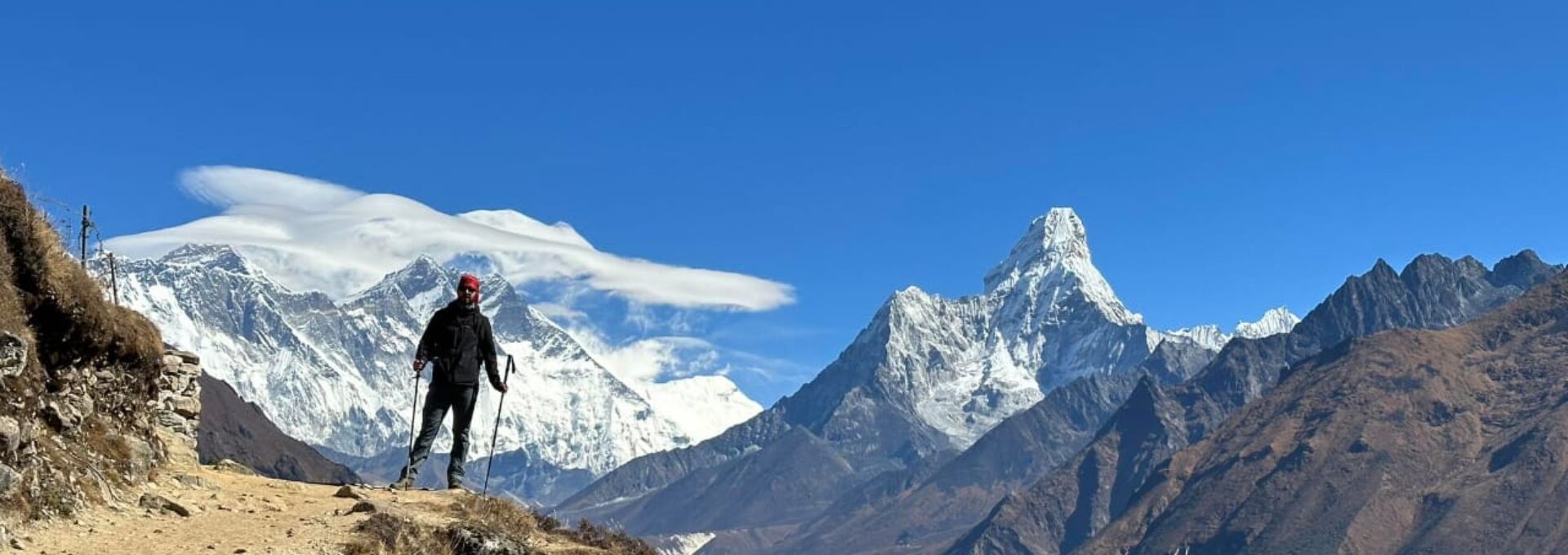
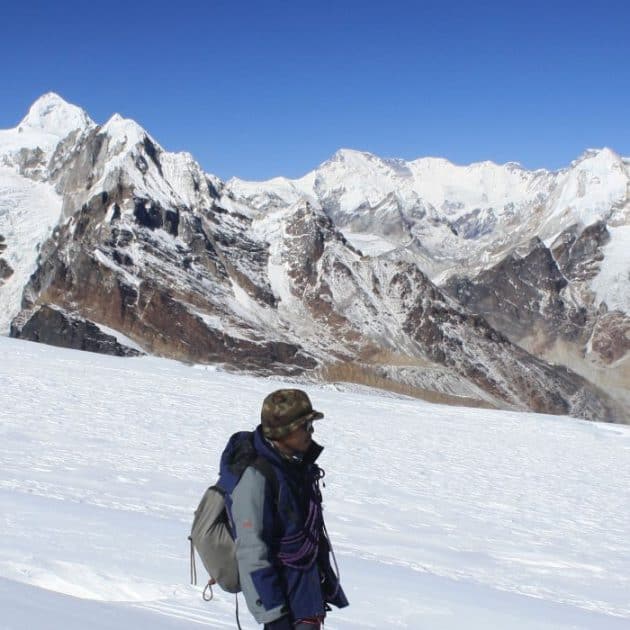
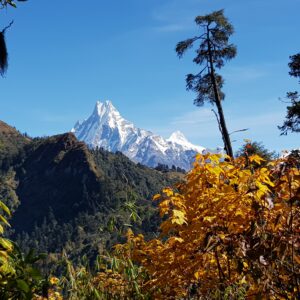
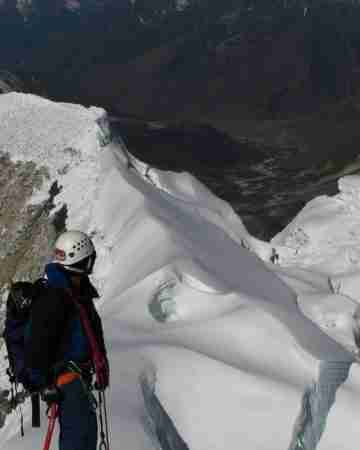
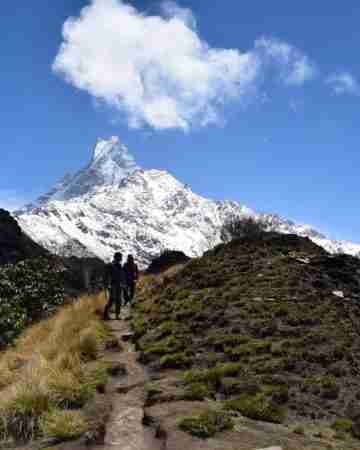
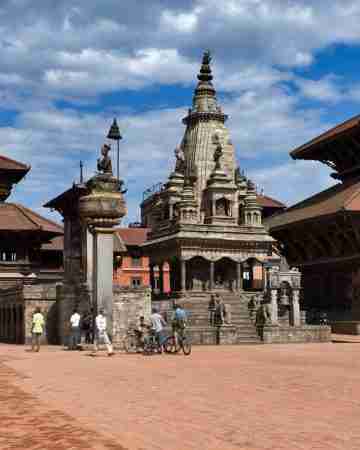
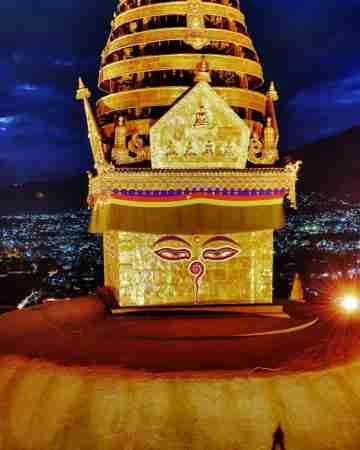

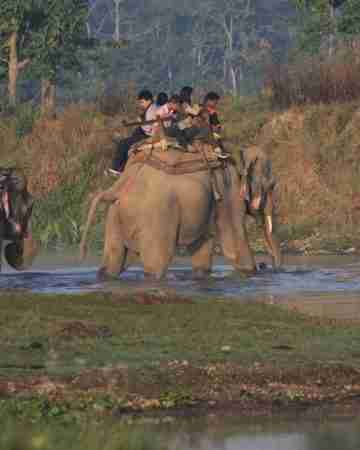
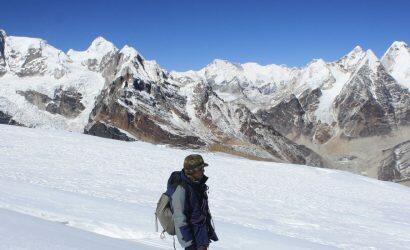
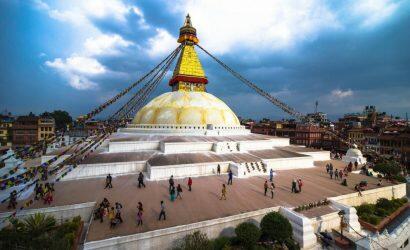
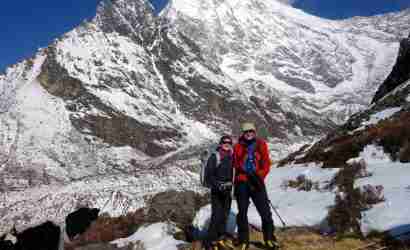
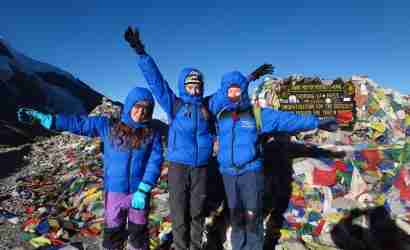
Nepal's acronym of Never Ending Peace And Love, does well to characterize this nation of good natured and accommodating people; a land of majestic Himalayan scenery comprising eight of the world's ten highest mountains, including Mt Everest: the uppermost place on earth at 29,029ft (8,848m).
Situated between India and Tibet, the Kingdom of Nepal is filled with many different ethnic groups, customs and traditions reflected in a wonderfully diverse geography.
Spread across these varied altitudes are communities of colorful cultures and people (many untouched by modern development), animated cities and towns, and far-flung mountain villages. Life here revolves around an intricate intermingling of ancient Hindu and Buddhist religious rituals. Numerous festivals are celebrated throughout the year colored by a diversity of religious and tribal traditions. The capital of Kathmandu brings an assortment of these different societies together into a vibrant collection of brilliant sights and exotic smells, with modern shops co-existing with street sellers, while pyramidal Buddhist temples, holy Sadhus of the Hindu faith and medieval palace squares fill the urban landscape.
Nepal has many attractions, but the essence of the country is its smiling, friendly people with their heartfelt palm-pressed greetings, and together with its inspiring scenery, this beguiling kingdom is a place where one visit is usually not enough to satisfy the captivated traveller. Find cheap Flights to Nepal with Cheapflights.
LOCATION: It borders with the Tibet Autonomous Region of the People's Republic of China in the North and India in the East, South and West respectively.
AREA: 147,181 sq. kilometers.
ALTITUDE: Varies from 70 meters to 8848 meters.
CAPITAL: Kathmandu.
POPULATION: 1,84,91,097
LANGUAGE: Nepali is the national language of Nepal. Educated people understand and speak English as well.
TIME: Nepal Time is 5 hours 45 minutes ahead of GMT and 15 minutes ahead of Indian standard time.
By Air
The Tribhuvan airport in Kathmandu is Nepal’s only international airport. The important airlines that serve Kathmandu are Indian Airlines, Thai International, Bangladesh Biman, China Southwest Airlines, Druk Air, Qatar Airways, PIA- Pakistan Airlines, Gulf Air, Sahara Ailrlines, Jet Air, and Cosmic Air. The national carrier - Nepal Airlines Corporation (NAC), operates flights to both Europe and Japan as well as the regional destinations.
Via Asia
You could travel to Kathmandu via Bangkok, Hong Kong and Singapore. There are daily flights to Kathmandu from bankgkok.
If in India, you can fly to Nepal from Delhi, Mumbai, Calcutta, Banglore and Varanasi. There is the spectacular flight from Lhasa to Kathmandu on Saturdays, Tuesdays and Thrusdays operated by China Southwest Airlines. You can also fly Druk Air from Paro in Bhutan, or take a flight from Dhaka, Bangladesh.
From Europe and Middle East
Qatar Airways and Gulf Air operates daily flights to Kathmandu from Doha and Dubai. Pakistan International, Bangladesh Biman and Aeroflot have one-airline service from Europe to Kathmandu.The other option are the charter companies, Austrin Airways has a direct flight from Vienna to Kathmandu and Martin Air operates direct flight to Kathmandu from Aamsterdam.
From North America
You could fly to Nepal via India or alternatively via Bangkok or Hong Kong. NAC’s Osaka flight makes good connections with North American flights.
From Australia and New Zealand
Look for routes via Singapore, Hong Kong or Bangkok.
By Land
There are just eight entry points into Nepal by land open to foreigners, from which six are from India and two from Tibet.
Via India
The crossing points from India include Mahendranagar, Dhangadhi and Nepalgunj in the west, Sunali, Birganj and Kakarbhitta in the east. Make sure to book your tickets through a reputed agency to avoid getting duped. Also bear in mind that everyone has to change buses at the border whether they book a through ticket or not, and that despite claims to the contrary, there are no tourist buses on either side of the border. You can board direct buses to the Nepal border from Delhi, Varanasi, Calcutta, Patna and Darjeeling. From the border, you can board Nepali buses to Kathmandu.
Nepal-India border
Via Tibet
You can cross the border into Nepal from Tibet via Kodari.
Passports
Valid passport required by all nationals referred to in the chart above.
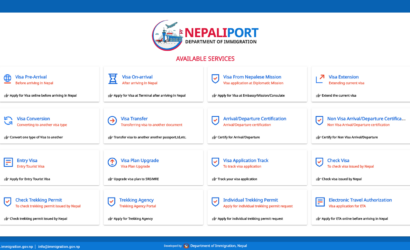
Visas
Required by all nationals referred to in the chart above except transit passengers continuing their journey by the same or first connecting aircraft on the same day provided holding valid onward or return documentation and not leaving the airport.
Visa Note
(a) All nationals referred to in the chart above may obtain tourist visas on arrival at the airport.
(b) Business can be conducted on a Tourist visa for up to 30 days.
(c) Nationals not referred to in the chart above are advised to contact the embassy to check visa requirements
Validity
Visas are valid for up to six months from date of issue. Visas are valid for 60 days on first visit to Nepal in a visa year (1 January - 31 December), but only valid for 30 days when national is visiting Nepal for the second or more time in a visa year. Visas may be extended in Nepal at the Department of Immigration, Kathmandu or the Immigration Office, Pokhara. Maximum stay in Nepal is 150 days in any calendar year. For full conditions on visa extension (including charges and conditions), contact the consulate (or consular section at embassy)
Applications to:
Consulate (or consular section at embassy). Visas can also be obtained on arrival from the Immigration authorities at all entry points (with fees payable in US Dollars) provided travelers are in possession of valid travel documents, two passport photos and the relevant fee. Applications for business visas must be made to the Department of Immigration (see above under Validity for contact details).
| Type of Visa | Valid Upto | Total Cost |
| Tourist multiple | 15 days | $25.00 |
| Tourist multiple | 30 days | $40.00 |
| Tourist multiple | 90 days | $100.00 |
| Business multiple | 15 days | $25.00 |
| Business multiple | 30 days | $40.00 |
| Business multiple | 90 days | $100.00 |
Download Visa Application Form..
All baggage is subject to customs' check at the point of entry. Visitors are allowed to bring in the consumable articles such as liquor one bottle up 1.15 litres, 200 sticks of cigarette, 15 rolls of photo film and 12 rolls of movie camera film. Visitors are also allowed to carry one binocular, one camera, one movie camera, one video camera, one radio, one tape recorder, one bicycle, one wrist watch, one set of fountain pen, one perambulator, 15 radio cassettes & 10 disk records into the country on the condition that they are declared and are to be taken back on return. Carrying narcotics, arms and ammunitions are strictly prohibited. Visitors can export souvenirs to their respective countries. The export of antiuques requires special certificate from the Department of Archaeology, National Archive Building, Ram Shah Path, Kathmandu, Gold, silver, precious stones, wild animals and their skins, horns, etc, all drugs whether processed or in their natural state, are prohibited to export.
International Departure Tax
This includes in Ticket Fee.
Domestic Departure Tax
Rs 170 per person
Nepal’s weather is generally predictable and pleasant. There are four climatic seasons:
(a) Spring : March-May
(b) Summer : June-August
(c) Autumn : September-November
(d) Winter : December-February.
The monsoon is approximately from the end of June to the middle of September. About 80 per cent of the rain falls during that period, so the remainder of the year is dry. Spring and autumn are the most pleasant seasons; winter temperatures drop to freezing with a high level of snowfall in the mountains. Summer and late spring temperatures range from 28ºC (83ºF) in the hill regions to more than 40ºC (104ºF) in the Terai. In winter, average maximum and minimum temperatures in the Terai range from a brisk 7ºC (45ºF) to a mild 23ºC (74ºF). The central valleys experience a minimum temperature often falling bellow freezing point and a chilly 12ºC (54ºF) maximum. Much colder temperatures prevail at higher elevations. The Kathmandu Valley, at an altitude of 1310m (4297ft), has a mild climate, ranging from 19-27ºC (67-81ºF) in summer, and 2-20ºC (36-68ºF) in winter.
Perched on the Southern slopes of the Himalayan Mountains, the Kingdom of Nepal is ethnically diverse. The Nepalese are descendants of three major migrations. These migrations have taken place from India, Tibet, and Central Asia. Among the earliest inhabitants were the Newar of the Kathmandu Valley and aboriginal Tharu in the southern Tarai region. The ancestors of the Brahman and Chetri caste groups came from India, while other ethnic groups trace their origins to Central Asia and Tibet, including the Gurung and Magar in the west, Rai and Limbu in the east, and Sherpa and Bhotia in the north.
In the Tarai, which is a part of the Ganges basin, much of the population is physically and culturally similar to the Indo-Aryan people of northern India. People of Indo-Aryan and Mongoloid stock live in the hill region. The mountainous highlands are sparsely populated. Kathmandu Valley, in the middle hill region, constitutes a small fraction of the nation's area but is the most densely populated, with almost 5% of the population.
Nepal's 2001 census enumerated 103 distinct caste/ethnic groups including an "unidentified group". The caste system of Nepal is rooted in the Hindu religion while the ethnic system is rooted in mutually exclusive origin myths, historical mutual seclusion and the occasional state intervention.
Nepal is blessed with one of the richest cultures in the world. Culture has been called 'the way of life for an entire society'. The statement holds particularly true in case of Nepal where every aspect of life, food, clothing and even occupations are culturally guided. The culture of Nepal includes the codes of manners, dress, language, rituals, norms of behavior and systems of belief.
Religion occupies an integral position in Nepalese life and society. In the early 1990s, Nepal was the only constitutionally declared Hindu state in the world. There is, however, a great deal of intermingling of Hindu and Buddhist beliefs. Many of the people regarded as Hindus in the 1981 census could, with as much justification, be called Buddhists.
The fact that Hindus worshipped at Buddhist temples and Buddhists worshipped at Hindu temples has been one of the principal reasons adherents of the two dominant groups in Nepal have never engaged in any overt religious conflicts. Because of such dual faith practic,es and mutual respect the differences between Hindus and Buddhists have been in general very subtle in nature.
Affiliated with